The strange thing about furnishing a small home is that the mistakes are almost never about size. They're about circulation. A room with one oversized sofa and clear paths around it feels bigger than the same room with four modest pieces you have to shuffle past.
So before the shopping list, the measurements.
1. Start with the walkways, not the furniture
Tape the floor before you buy anything. Mark the paths you take every day — door to sofa, sofa to kitchen, bed to wardrobe — and protect them. Whatever's left is your furniture budget, in centimetres.
| Gap | Allow | Why |
|---|---|---|
| Main walkway | 75 cm | One person walking normally, carrying something |
| Secondary path | 60 cm | Squeezing past occasionally is fine here |
| Behind dining chairs | 90 cm | Pushing back and standing up without hitting a wall |
| Sofa to coffee table | 40–45 cm | Close enough to reach a mug, far enough for shins |
| In front of a wardrobe | 90 cm | Door swing plus room to actually stand and look |
2. Buy furniture with visible legs
This is the highest-impact rule in small-space furniture, and it costs nothing. A sofa on 15 cm legs shows a strip of floor underneath; a sofa with a skirt to the ground stops the eye dead. The floor you can see reads as space you have.
Same logic for a glass or open-frame coffee table, a console with an open shelf rather than a solid box, and a bed frame that floats rather than sitting on a plinth. You're not making the room bigger — you're removing the visual walls inside it.
3. Make every large piece do two jobs
In a small home, floor area is the currency, and any piece that only does one thing is expensive. Multifunctional furniture worth the money:
- Storage ottoman as coffee table. Holds blankets and board games, becomes extra seating when six people turn up, and has no sharp corners. Put a solid tray on top and it's a perfectly good table.
- Nesting side tables. One table most days, three when you're hosting, stacked into one footprint the rest of the time.
- Bed with drawers underneath. The most underused storage volume in any flat. A divan or drawer base typically replaces an entire chest of drawers.
- Extendable dining table. A 90 cm square that opens to 140 cm covers both a Tuesday breakfast and a dinner for six.
- Console that doubles as a desk. Behind a sofa it's a console; pull a chair up and it's a laptop station, with none of the visual weight of a real desk.
One warning on sofa beds: choose based on the mode you use daily. A sofa bed slept on every night wears out quickly and sleeps worse than a real mattress. Used a few times a year for guests, it's one of the best-value pieces you can own.
4. Storage that goes up, not out
Small rooms almost always have unused wall above 150 cm. Using it is the difference between a flat that feels cluttered and one that doesn't.
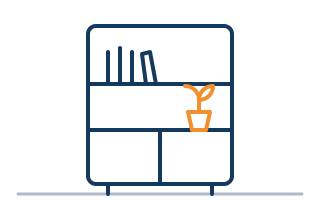
The trick is keeping it from feeling top-heavy. Three rules that reliably work:
- Go floor to ceiling, or stop well short. A unit that ends 30 cm below the ceiling creates an awkward dust shelf and draws a line across the room. Either fill the height or keep it under eye level.
- Keep the bottom third closed and the top two-thirds open. Closed doors low down hide the mess; open shelves up high stay visually light.
- Match the unit's colour to the wall. A white shelf on a white wall almost disappears. A walnut one on a white wall is a piece of furniture standing in your room.
Wall-hung units — a floating sideboard, a shelf-mounted bedside table — take this further by giving the floor back entirely. They need proper fixings, so check the wall type before ordering.
5. Seating: fewer, better, movable
The instinct in a small living room is to buy small: a compact two-seater plus two little armchairs. It usually backfires. Four small pieces create four sets of edges and gaps, and the room reads as busy.
One properly sized sofa plus one or two light, movable seats works better. Look for a two-seater around 160–180 cm wide with slim arms — arm width is the hidden variable, and swapping 20 cm arms for 10 cm ones buys you a genuinely usable extra seat position at the same overall footprint.
For the extra seats, pick something you can lift with one hand: a low stool, a folding chair worth looking at, a small cane-backed chair. They live against a wall and come out when needed. And if you're likely to move within a few years, a modular sofa is the sensible bet — two modules now, four in the next place.
6. The dining problem
Most small flats can't fit a real dining table without losing the living room, so people give up and eat on the sofa. Three ways round it:
- A round 90–100 cm table in the corner. Round tables tuck into corners and walkways in a way rectangles can't, and with a pedestal base there are no legs to negotiate.
- A drop-leaf against the wall. A 40 cm console most of the week, a 90 cm table on Sunday. The best of these look like furniture, not like a folding table.
- A breakfast bar with stools that fully tuck. Measure the tuck: stools that stick out 10 cm defeat the purpose entirely.
7. Rental-friendly, no-drill solutions
If you can't make holes, you can still do most of this:
- Freestanding tall units instead of wall-mounted shelves — narrow-footprint bookcases give the same vertical storage with a safety strap rather than a bracket.
- A tension rod across an alcove creates a hanging rail or a curtained storage bay with zero fixings.
- Peel-and-stick hooks rated by weight — genuinely fine for coats and mirrors under about 3 kg, genuinely not fine for shelves.
- A large rug to zone the room. In a studio, one rug under the sofa area and none under the bed does more to separate "living" from "sleeping" than any divider.
- Floor lamps instead of ceiling changes. Two warm lamps at different heights will fix a rental's grim overhead light without touching the wiring.
Five mistakes that shrink a room
- Pushing everything against the walls. It looks like it should create space; it actually creates a dead hole in the middle and a room that reads as a waiting area.
- A rug that's too small. A rug where the sofa's front legs don't reach makes the whole seating area look like it's floating. Front legs on the rug, minimum.
- Too many small pieces. Three tiny tables take more visual space than one decent one.
- Only one light source. A single ceiling light flattens a room and pushes the corners into shadow, which makes it read as smaller.
- Curtains hung at the window frame. Hang the rail close to the ceiling and wider than the window — the wall reads as a taller, larger opening.
Frequently asked questions
What size sofa works in a small living room?
A two-seater around 160–180 cm wide, seat depth near 55 cm, with slim arms. Arm width matters more than most people expect — trading 20 cm arms for 10 cm ones adds a usable seat position without changing the footprint at all.
How do you make a small room look bigger with furniture?
Raise things off the floor and keep sightlines open. Visible legs, an open-frame or glass coffee table, wall-hung storage and one large rug instead of several small ones all let the eye travel further — which the brain reads as more space.
Is a sofa bed worth it in a studio apartment?
Only if you'll genuinely use both modes. Slept on nightly, it wears out fast and sleeps worse than a real mattress. Used for guests a few times a year, it's one of the best-value pieces in a small home.
How much walking space do you need around furniture?
About 75 cm for a main walkway, 60 cm for a secondary one, 90 cm behind dining chairs, and 40–45 cm between sofa and coffee table.
Should small rooms have small furniture?
No — they should have fewer pieces, correctly scaled. One properly sized sofa beats a compact sofa plus two small armchairs, because every extra piece adds edges and gaps that make the room read as busy.
The short version
Protect the walkways, buy pieces with legs, make anything large do two jobs, and use the wall above 150 cm. Do those four things and you can furnish a small flat with real furniture rather than miniature versions of it.
If you're also weighing style, our 2026 furniture trends report covers which of this year's trending pieces work in tight rooms — modular seating and round pedestal tables both earn their place.